Community Empowerment Incubator
From Awareness to Action
The Community Empowerment Incubator is where community members turn knowledge into organized action. We provide tested tools, facilitation guides, and peer support to help neighbourhoods, temples, workplaces, and cultural groups build their own self-sustaining community safety and support networks — without ever crossing into vigilantism.
Everything here follows one principle: solidarity, not confrontation. We educate, coordinate, and support. We do not investigate, expose, or retaliate.
On This Page
- Toolkit Hub — Starter kits and workshop modules
- Start a Safety Circle — Neighbourhood mutual-aid
- Build Capacity — Sustainability planning
- Data and Safety Boundary — What never to collect
Data and Safety Boundary
Do not collect: victim names, addresses, suspect names, screenshots, payment records, phone numbers, or case evidence. Do not create local lists of victims or suspects.
Local action should focus on: awareness, referral pathways, aggregate needs, and connection to police/victim services.
This boundary protects everyone. Breaking it endangers victims and may violate privacy laws.
Toolkit Hub
Each module below is designed to be downloaded, printed, and adapted for your community. All follow the same safety boundaries.
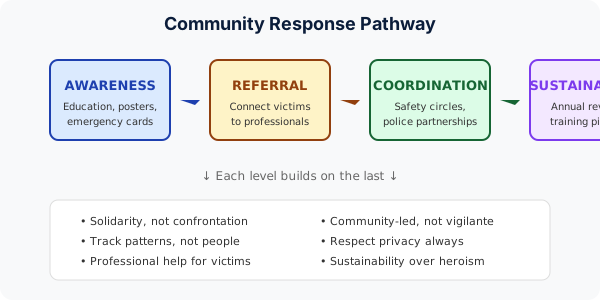
Where to start? The Incubator is organized as a four-level pathway. Each level builds on the last:
| Level | Name | What it means | Key tools |
|---|---|---|---|
| 1️⃣ | Awareness | Community knows extortion is happening and where to get help | Posters, emergency cards, education sessions |
| 2️⃣ | Referral | Community members confidently connect victims to professional services | Faith leader training, business protocols, listener guide |
| 3️⃣ | Coordination | Community groups work with each other and police safely | Safety circles, police meeting agendas, pattern tracking |
| 4️⃣ | Sustainability | Systems persist and adapt without relying on a single person | Annual reviews, training pipelines, succession planning |
Community Response Pathway
🆕 Community Starter Kits
Ready-to-use toolkits for specific community groups:
- Faith Community Starter Kit — Complete guide for gurdwaras, mandirs, mosques, churches. Includes first-conversation scripts, confidentiality agreements, meeting agendas, and printable posters.
- Business Starter Kit — Incident response protocols, evidence preservation checklists, staff training guides, and business continuity planning for South Asian-owned businesses.
- Neighbourhood Safety Circle Kit — How to build a local support network that helps without vigilantism. Ground rules, recognition guides, safety planning templates.
🛡️ Start a Safety Circle
Purpose: Build a neighbourhood or building-level mutual-aid network for check-ins and support.
Who should use it: Neighbourhood leaders, building representatives, trusted community members.
Time required: 2–3 hours to launch; 30 minutes/week to maintain.
What you need: 3–5 committed contacts, a private communication channel (Signal or WhatsApp), this guide.
Safety boundary: For emotional support and logistics only. Never share evidence, suspect names, or victim details. Threat = call 911 first.
Download: Full guide (web)
🏛️ Run a Community Meeting
Purpose: Hold a safe, informed community gathering about extortion without creating panic.
Who should use it: Gurdwara/mandir/mosque leadership, cultural association presidents.
Time required: 3–4 hours prep; 1–1.5 hours meeting.
What you need: Venue, trusted facilitator, printed materials, VictimLink contact on screen.
Safety boundary: No identifying details. No open-mic victim disclosures. Refer individuals to private conversations with victim services.
Download: Faith Leader Response Guide (web) · Emergency card (printable)
📞 Build a Trusted Contact Tree
Purpose: Create a phone/SMS network so no one faces a threat alone.
Who should use it: Block captains, senior centre coordinators, family-network organizers.
Time required: 1–2 hours to map; 15 minutes/week to maintain.
What you need: Consenting contacts, phone numbers, clear escalation protocol.
Safety boundary: Contact tree is for wellness checks and logistics only. Never discuss active cases or evidence. Keep tree membership confidential.
Download: Business response kit (web) · Emergency card (printable) · Contact tree guide (web)
👮 Meet With Police
Purpose: Prepare for and hold a productive first meeting with local police or victim services.
Who should use it: Community leaders who have established trust with their membership.
Time required: 2 hours prep; 1 hour meeting; 1 hour follow-up.
What you need: 2–3 community representatives, list of questions, printed reporting pathways in community languages.
Safety boundary: Share patterns only, never individual cases. Bring general concerns, not names or addresses. Respect police confidentiality.
Download: Meeting agenda + prep checklist (web)
📊 Track Patterns Safely
Purpose: Gather useful community intelligence without collecting personal data.
Who should use it: Community researchers, workshop coordinators, data-minded volunteers.
Time required: 1 hour to set up; ongoing light maintenance.
What you need: A simple spreadsheet or notebook, clear categories, this guide.
Safety boundary: Track only: public reports, service gaps, language needs, workshop requests, aggregate concerns. Never collect: names, addresses, screenshots, payment records, immigration details, case specifics.
Download: Safe data guidelines (web) · Tracking worksheet (web)
🤝 Support a Victim Without Investigating
Purpose: Help someone who discloses extortion while staying within safe boundaries.
Who should use it: Faith leaders, community elders, trusted peers, workplace HR.
Time required: 30 minutes to read; 1–2 hours per support interaction.
What you need: Calm presence, VictimLink number, evidence-preservation guidance.
Safety boundary: Believe, comfort, refer. Do not investigate, confront, or share identifying details. Follow up within 24–48 hours.
Download: Support protocol card (web)
📱 WhatsApp Group Rules
Purpose: Establish safe norms for community WhatsApp groups so they help rather than harm.
Who should use it: Group admins, community organizers, faith leaders.
Time required: 30 minutes to read; 15 minutes to implement.
What you need: Admin access to the group, this ruleset, patience to enforce.
Safety boundary: No victim names, no suspect names, no evidence screenshots, no speculation about active cases. Remove rule-breakers promptly. Refer to professionals.
Download: Digital security guide (web)
🗣️ Rumour Control Guide
Purpose: Correct false information without amplifying it.
Who should use it: Community communicators, social media admins, spokespersons.
Time required: 1 hour to read; 15 minutes per correction.
What you need: Verified facts from police or official sources, this guide.
Safety boundary: Correct with facts, not emotion. Never repeat the false claim in your correction. Never share identifying details. When in doubt, say less.
Download: Corrections log example (web)
Block-Ready Mutual-Aid Protocols
Ready-to-use plans for trusted neighbours to check in on one another, share verified information, and ensure no one faces a threat alone.
- Quick-start checklist — Assess your block or building’s readiness in 30 minutes · Full guide
- Trusted-contact tree — Template for building a phone/SMS check-in network · Download worksheet
- Safe-communication channels — Encrypted group chat setup guide (Signal, WhatsApp) · Digital security guide
-
Community–Police meeting agenda — First meeting with police: prep, questions, safety boundaries · Download agenda
Warning: Encrypted chats are for logistics and mutual support only — never for sharing evidence, naming suspects, discussing active investigations, or circulating victim details. If a threat is imminent, the protocol is: call 911, then notify your contact tree.
- Scenario drills — What to do if a neighbour receives a threat; who calls whom, in what order
These protocols are for preparedness and emotional safety, not physical intervention. If a threat is imminent, the protocol is: call 911, then notify your contact tree.
Temple, Gurdwara & Mosque Safety Circles
Faith communities are often the first place people turn when in trouble. These guides help leadership and volunteers create a compassionate, safe response system.
Leadership Briefing Deck
How extortion works, why victims stay silent, what leadership can do
Time: 1 hour
Confidential Listener Training
Active listening, safety planning, when and how to refer to professionals
Time: 4 hours
Safety Planning Guide
Steps for someone feeling targeted: securing documents, phones, banking, children
Time: 2 hours
Community Announcement Templates
How to warn congregations without creating panic or sharing operational detail
Time: 30 minutes
All materials are reviewed for safety and cultural appropriateness. Reviewers include victim-services practitioners, legal-resource reviewers, community-language reviewers, and public-safety advisors. Names are withheld unless reviewers consent to attribution.
Reviewed by role, not name: victim-services practitioner, legal-resource reviewer, community-language reviewer, public-safety advisor.
Workplace & Business Response Kits
Employers — especially in sectors with many South Asian workers — need clear, legal, and compassionate policies for when employees are targeted.
- HR policy template — Responding to an employee who discloses extortion
- Manager checklist — First conversation, confidentiality, referrals, time-off considerations
- Security liaison guide — Working with building security and local police without escalating risk
- Post-incident support — Return-to-work considerations, ongoing check-ins, preventing gossip
These kits are designed to be reviewed with input from labour lawyers and employee-assistance professionals.
Youth & Student Organizing Kits
Young people are on the front lines of sextortion and social-media-based threats. These peer-led tools help student groups, youth clubs, and campus organizations respond.
- Peer-support conversation guide — How to talk to a friend who says they’re being threatened
- Digital-hygiene workshop — Locking down social media, understanding metadata, safer sexting conversations
- Campus advocacy brief — What to ask your student union, security office, or counselling centre for
- Social media response guide — How to support someone publicly without making them a target
All content is designed to be reviewed by youth counsellors and emphasizes that trusted adults — not peer networks — should handle active threats.
How the Incubator Works
Start With a Conversation
You don’t need permission or credentials to begin. The first step is always: talk to the people you trust. Ask:
- Has anyone here heard of this happening in our community?
- Do people know where to go for help?
- What would make someone feel safe enough to speak up?
These conversations surface needs without creating pressure to disclose personal cases.
Register Your Interest
Before joining Network calls, we ask community organizers to complete a brief intake. This helps us understand who is building capacity, where, and how to support safely.
Privacy note: We use organizer contact details only for coordination — connecting you to tools, Network calls, and peer organizers. We do not share names with police, media, or other organizations without explicit consent. Details are retained only while actively supporting your initiative.
Email: incubator@stop-extortion.ca with:
- Your name and community or organization
- What you are building (e.g., neighbourhood mutual aid, temple safety circle, workplace response)
- Whether you have a police or victim-services contact (not required, but helpful)
- Confirmation that you agree to the Guiding Principles above
What happens next:
- We review within 5 business days
- We schedule a brief call to understand your context and needs
- We connect you to relevant tools, training, or other organizers
- You receive invites to Network calls and early access to new resources
This is not an approval process — it is a safety and alignment check. We want to help, and we want to make sure our support matches your context.
Use Our Tools
Everything on this page is designed to be:
- Practical — Step-by-step, not theoretical
- Adaptable — Adjust for your community’s size, language, and cultural norms
- Legal and safe — Reviewed to ensure nothing encourages retaliation or privacy violations
- Free and open — Read, translate, print, and share without restriction. The intake above is only for Network calls; the tools themselves are openly downloadable with no registration required.
Connect With Others
You are not starting from scratch. Join our quarterly Incubator Network calls where community organizers share what worked, what didn’t, and what they need next.
- Next call: Network calls are held quarterly. Email incubator@stop-extortion.ca to be added to the invite list.
- Format: Virtual, with live Punjabi and Hindi interpretation available
- Who should attend: Anyone actively building or considering community response structures
Share Feedback
These tools improve because communities tell us what’s missing. After using a guide or running a workshop, please send feedback:
- What worked?
- What was confusing?
- What cultural context did we miss?
- What would you add?
Email: incubator@stop-extortion.ca
Guiding Principles for All Community Action
Every tool and training in the incubator is built on these non-negotiables:
Victim safety first
Every decision prioritizes the physical and emotional safety of the person being targeted.
No vigilantism
We do not investigate suspects, track individuals, or gather intelligence. We support victims and strengthen reporting.
Privacy by design
No one is required to share their story publicly. No lists of victims are kept. No identifying details are shared without explicit consent.
Cultural humility
We meet communities where they are. We don't impose Western frameworks or assume one-size-fits-all solutions.
Accountability to professionals
Community action complements — never replaces — police, victim services, and legal professionals.
Trauma-informed
We assume anyone involved may be carrying trauma. Our language, pacing, and expectations reflect that.
Use Local Data Safely
Communities need to understand what’s happening locally — but collecting information about crimes carries serious responsibility. Here is how to gather useful, ethical intelligence without becoming investigators.
What You Can Track
Public reports
News articles, police statements, community advisories
Service gaps
"We need a Punjabi-speaking counsellor in our area"
Language needs
"Our seniors need materials in Hindi, not just Punjabi"
Workshop requests
"Three gurdwaras asked for prevention workshops"
Aggregate concerns
"Multiple people mentioned WhatsApp-based immigration threats"
What You Must NOT Track
Never collect: victim names, suspect names, addresses, screenshots of threats, payment records, immigration details, or individual case details.
Why: Identifies people who may be in danger. You are not investigators. Evidence belongs with police. Financial and immigration data is sensitive.
The Rule
Track patterns, not people. Count the number of people asking for help in a language. Note the types of threats being reported publicly. Identify service gaps. Do not build a database of victims.
Work With Police and Local Agencies
Community groups and law enforcement can collaborate effectively — but only when roles are clear.
📋 Suggested First Meeting Agenda
This agenda is available as a printable checklist. Download it here: Community–Police Meeting Agenda
Key topics covered: local patterns, victim response, evidence preservation, community role boundaries, liaison contacts, language needs, rumour correction, public updates, and next steps.
Before the meeting: Decide who attends (2–3 people), agree on what information to share (patterns only), prepare urgent questions, bring printed reporting pathways in community languages.
After the meeting: Share general outcomes only ("Police confirmed they are seeing X pattern; they asked us to encourage reporting"). Do not share operational details or anything marked confidential by police. Schedule the next meeting.
See the downloadable agenda for the full checklist and printable version.
Media & Community Briefings
When community leaders speak to media, local officials, or anxious neighbours, the message must be accurate, defensible, and calm. These talking points trace directly to dated Surrey Police Service reports and are framed for a skeptical audience.
The Core Facts
- Extortion targeting Surrey’s South Asian community went from near-zero to a sustained monthly presence over 2025, peaking at 44 police files in a single month in January 2026.
- This is not a one-month spike. The pattern has held for eight straight months.
- Two-thirds of these files are concentrated in one district, which tells investigators where to look and communities where support is most needed.
- Extortion and shots-fired rose together, which points to coercive enforcement rather than ordinary fraud.
- These are police files, not victim counts, and the early-period percentages rise off a very low base. The trajectory of monthly counts is the honest measure, and it is clear.
- Every figure traces to a dated Surrey Police Service report, so the claims are checkable.
Framing Notes for Leaders
If asked “Is this getting worse?”
The numbers show a sustained pattern, not a one-month spike. What matters is that we have eight months of consistent police files, which means this is real and ongoing — and it means we know where to focus help.
If asked “Should people be afraid?”
People should be informed, not afraid. Fear helps extortionists. What helps victims is knowing how to report, who to call, and that their community stands with them.
If asked “What can the community do?”
Three things: encourage reporting, reduce shame so people feel safe to speak up, and connect people to victim services and police. We do not investigate or confront anyone — that is law enforcement’s role.
If asked about percentages or “1,008% increase”
That percentage is mathematically correct but misleading. It rises off a base of 12 files. The honest story is “near-zero to sustained presence.” The monthly file count is the measure that matters.
Source Citation (for media or official correspondence)
Surrey Police Service Crime Statistics Reports (PRIME RMS), January 2025 – April 2026. Surrey Police Service became police of jurisdiction on 29 November 2024. Counts are police files, not victims. Data are preliminary and subject to revision.
In Development
The following resources are in active development with community partners. If you have expertise or want to pilot-test, please reach out.
- Seniors’ safety network guide — Addressing the particular isolation and vulnerability of seniors facing extortion
- Rural and small-town toolkit — For communities without in-person South Asian service providers
- Legal navigator companion — Plain-language guide to working with lawyers, Legal Aid, and immigration counsel when extortion intersects with immigration status
- Family communication toolkit — How families can talk about threats without shame or blame, especially across generational divides
Get Started
Request a workshop or training
workshops@stop-extortion.ca
Share feedback on a tool
incubator@stop-extortion.ca
Join the Incubator Network call
incubator@stop-extortion.ca (ask to be added to the list)
Propose a new tool or partnership
partners@stop-extortion.ca
Volunteer to help build or translate resources
volunteer@stop-extortion.ca
A Final Note
Extortionists depend on silence, shame, and isolation. The most powerful thing a community can do is make it impossible for those three things to survive. That doesn’t mean confrontation. It means connection. It means everyone knowing the signs, everyone knowing where to turn, and no one having to face it alone.
Build that. We’ll help.
Last reviewed: June 2026 · Next review: September 2026
| Home | What To Do | Report | Get Help Now | Community | About |